
Get More Work Through the Same Team—Without Losing Control of the Jobs
Your best people should be moving bids, jobs, clients, and decisions forward.
Instead, they are chasing RFIs, copying field notes, checking for missed addenda, following up on quotes, rebuilding reports, and hunting through inboxes for the latest answer.
The Simple AI System gives construction companies more capacity, cleaner field-to-office handoffs, faster follow-up, better visibility into margin and cash flow, and less owner dependency—without replacing experienced people or forcing the team into another disconnected platform.
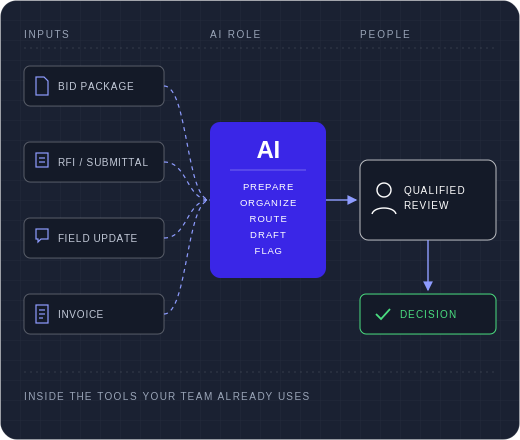
Bluthrive maps one recurring bottleneck, redesigns the process, and installs the automation inside the tools your team already uses. AI prepares, organizes, routes, drafts, and flags. Your qualified people review and decide.
Done-for-you implementation. First useful automation live within 14 days. Then one new production-grade automation installed each month.
$800/month. Cancel any month. Protected by a 30-day, no-questions-asked money-back guarantee.
Start with the workflow creating the most drag. Leave the call with a clearer view of what to fix first.
This Is What Growth Feels Like When the Operation Cannot Keep Up
The company wins more work. The backlog grows. More people touch every job.
But the operating system underneath the business still depends on texts, memory, spreadsheets, inboxes, and the owner knowing where everything stands.
That is when growth starts creating drag instead of capacity.
Nothing looks broken enough to stop the jobs.
But too much work moves late, twice, or only after someone follows up.
That pressure shows up in slow decisions, delayed billing, missed details, stretched people, thinner margins, and cash tied up longer than it should be.
—
Estimators spend too much time checking documents and chasing coverage instead of pricing the next opportunity.
—
Project managers manually pull information from emails, meeting notes, drawings, and job systems just to decide what needs attention.
—
Superintendents send critical field updates, but the office still has to interpret, re-enter, and route them.
—
Accounting sees billing, WIP, job-cost, and cost-to-complete information after the window to act has narrowed.
—
The owner becomes the final search engine, reminder system, and approval path for the company.
The question is not whether your team works hard. The question is how much skilled capacity disappears into work a better process should handle.
The Work Is Moving. The Information Is Not.
Before the job
A bid package lands with hundreds of pages and a tight deadline. Your estimator has to find scope changes, compare addenda, check exclusions, organize questions, and keep vendor quotes moving.
The real risk is not only time. It is the detail buried on page 147 that someone needed to flag before the number went out.
Then the bid is submitted, and follow-up depends on a note, a calendar reminder, or someone remembering to call.
During the job
RFIs, submittals, meeting actions, daily reports, and drawing revisions are spread across inboxes, project platforms, shared drives, and text threads.
The latest information exists. It is just not always in front of the person who needs it next.
A field update arrives by text. Someone in the office copies it into another system. A meeting action sits in notes. A revised drawing is uploaded, but the right person does not see the change soon enough.
The handoff works—until volume rises, someone is out, or the job gets complicated.
When scope changes
The crew completes extra work because the schedule cannot wait.
The photos, labor, material notes, and client direction may be scattered across several people and systems. The change-order paperwork catches up later—after the facts are harder to reconstruct and the billing conversation is harder to control.
When the numbers arrive
Job-cost, billing, WIP, and cost-to-complete reports are useful only while there is still time to act.
If the information arrives late, the team is not managing the job. It is explaining what already happened.
When cash needs attention
Invoices go out. Collections depend on repeated follow-up. An important reply gets buried. A missing document delays payment. The owner or controller gets pulled back into another chase.
When the company depends on one person
One estimator knows how the bid really comes together.
One PM knows where the job stands.
One superintendent knows what happened in the field.
The owner knows which clients, vendors, or issues need attention.
That knowledge is valuable. It should guide decisions—not remain trapped in one person’s inbox or memory.
Same Team. Same Core Software. More Capacity and Job Control.
✓
Bid documents arrive, and the system organizes the package, surfaces changes, prepares a review list, and routes it to the estimator.
✓
Addenda and exclusions are easier to check before the bid goes out.
✓
Quote follow-up is prepared and scheduled instead of left to memory.
✓
RFIs, submittals, meeting actions, and drawing revisions reach the right person with clearer context.
✓
Field updates move into the office workflow without someone copying the same information by hand.
✓
Change-order documentation is assembled sooner while the details are still fresh.
✓
Job-cost, billing, WIP, and cost-to-complete inputs are organized for faster human review.
✓
Invoice and collection follow-up stays visible and consistent.
✓
Owners spend less time locating information, repeating instructions, and pushing routine work forward.
The estimator still owns the estimate.
The PM still owns the job.
The superintendent still owns field execution.
Accounting still reviews the financial information.
The owner still controls the commitments that matter.
The difference is that qualified people receive better-prepared work, faster. They use their judgment where judgment belongs.
Do Not Start With an AI Tool. Start With the Bottleneck.
Most failed automation efforts begin with a product demo.
The tool looks useful. Someone buys it. Then the team has to figure out where it fits, who owns it, how it connects to the current process, what needs review, and whether anyone is actually using it.
That is backwards.
The Simple AI System is process-first, not tool-first.
Bluthrive starts with the work as it actually happens:
AI CAN
AI can prepare, organize, route, draft, compare, summarize, and flag.
AI SHOULD NOT
It should not make unchecked decisions about money, contracts, safety, measurements, pricing, scope, approvals, or client commitments.
01
Map the real workflow.
02
Identify the biggest recurring bottleneck.
03
Redesign the process before writing code.
04
Define the limited role AI should play.
05
Keep qualified human review at the decision points that carry risk.
06
Build the automation into the tools the team already uses.
07
Train the people who will use it.
08
Measure time saved, turnaround, errors caught, and adoption.
09
Move to the next bottleneck the following month.
Your people stay in control. The system removes the avoidable work around their decisions.
What the Simple AI System is not
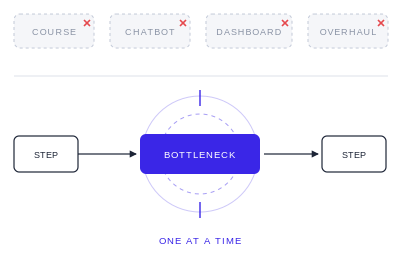
It is not:
✕
A course your team has to finish before anything changes
✕
A chatbot sitting beside a broken process
✕
Another dashboard to monitor
✕
A software subscription your team must configure alone
✕
A generic automation template dropped into every company the same way
✕
An attempt to replace estimators, project managers, superintendents, or accounting staff
✕
A company-wide technology overhaul before you see a useful result
✓
It is done-for-you implementation around one real operational bottleneck at a time.
From $22M to $45M in Six Months—With People Still in Control
Marco was a non-technical construction owner.
He did not need to become an AI expert. He needed AI implemented correctly around the right processes, with clear oversight and a practical role for his team.
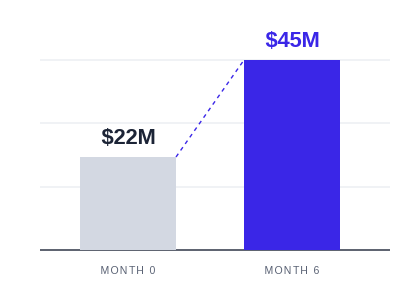
After implementing AI that way, his company grew from $22 million to $45 million in six months.
The important lesson is not that one tool created the growth. It did not.
The operational capacity needed to support that growth came from implementing AI around the right processes while keeping people in control.
Marco’s result is one specific client example. It is not a promise or a typical-results claim. Company growth depends on many factors, and the Simple AI System should not be treated as the sole cause of his company’s growth.
Bluthrive brings practical implementation experience to the work:
65+
AI implementations completed
12+
years implementing AI from Cristian
25+
years in automation from Cristian
The work is not to make construction look more technical.
The work is to help a construction company run with more capacity, clearer handoffs, and better control.
One Bottleneck at a Time. One Useful System at a Time.
Before implementation: choose the right starting point
On the Free Operations Roadmap Call, the conversation starts with the operation—not a software pitch.
Where does work wait?
Where is information copied, chased, or rebuilt?
Which recurring process pulls skilled people away from bids, jobs, clients, and decisions?
Which bottleneck affects turnaround, errors, margin visibility, cash flow, or owner involvement?
That gives the first implementation a clear operational target.
Month 1: map, redesign, build, and launch
Bluthrive maps the real workflow with the people who do the work.
Then the process is redesigned before code is written. Inputs, handoffs, exceptions, review points, approvals, and ownership are made clear.
Bluthrive builds the first production-grade automation into the tools the team already uses, trains the users, and gets the first useful automation live within 14 days.
The goal is not to automate every step. The goal is to remove repetitive work while preserving qualified review and accountability.
Month 2: measure and address the next constraint
Bluthrive checks how the first automation is performing:
Time saved
Turnaround time
Errors caught
Team adoption
Then the next recurring bottleneck is selected from the roadmap.
A new production-grade automation is installed that month.
Month 3 and beyond: build operating capacity month by month
Each month follows the same discipline:
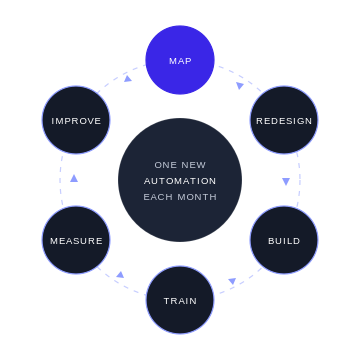
Map. Redesign. Build. Train. Measure. Improve.
The team gets one new production-grade automation installed each month, while existing automations remain monitored and maintained.
Over time, the company builds a set of connected, useful workflows instead of a pile of disconnected tools.
What Could You Fix First?
The first workflow depends on where your business is losing the most capacity or control. Examples include:
Bid package review
Organize bid documents, identify revisions, compare addenda, surface exclusions, and prepare a structured review list for the estimator.
Human control: The estimator verifies scope, quantities, measurements, pricing, assumptions, and the final bid.
Quote and proposal follow-up
Track open quotes, prepare follow-up messages, route replies, and flag opportunities that need personal attention.
Human control: Your team decides the message, negotiation position, pricing, and client commitment.
RFI and submittal coordination
Organize incoming items, summarize context, prepare routing, flag aging items, and keep required follow-up visible.
Human control: The PM and other qualified reviewers verify technical content, contractual impact, approvals, and commitments.
Meeting actions and daily reports
Turn meeting notes and field reports into organized action lists, assigned follow-up, and visible exceptions
Human control: The project team confirms accuracy, ownership, safety implications, and next actions.
Drawing revision control
Surface revised documents, prepare change summaries, and route review tasks to the right people.
Human control: Qualified staff verify the drawings, measurements, constructability, scope, safety, and downstream impact.
Field-to-office handoffs
Capture structured field updates and move them into the office workflow without relying on manual copying from texts or memory.
Human control: The superintendent and PM validate conditions, decisions, quantities, scope, and client communication.
Change-order documentation
Organize field notes, photos, labor information, material details, direction received, and related correspondence into a review-ready package sooner.
Human control: Qualified staff verify entitlement, scope, pricing, contract terms, approvals, and what is sent to the client.
Job-cost, billing, WIP, and cost-to-complete preparation
Gather and organize inputs, flag missing information, and prepare review-ready summaries so financial information can be assessed sooner.
Human control: Accounting, operations, and leadership validate the numbers and make the financial decisions.
Invoice and collection follow-up
Keep due items visible, prepare follow-up, route replies, and flag accounts that need direct attention.
Human control: Your team controls tone, escalation, disputes, payment terms, and client commitments.
Internal knowledge capture
Turn repeatable know-how from estimators, PMs, superintendents, and owners into usable checklists, review steps, and operating guidance
Human control: Experienced people verify what is correct, what is job-specific, and what should never be standardized.
These are examples, not promises that every workflow can or should be automated. The roadmap call identifies the best starting point for your operation.
The Simple AI System
$800 per month
Third-party platform subscriptions are separate and billed directly by the providers.
✓
Done-for-you implementation
Bluthrive handles the process redesign, build, installation, and team training. Your company provides operational context, access, feedback, and the qualified reviewers needed to keep decisions under human control.
✓
First useful automation live within 14 days
The first implementation targets one defined recurring bottleneck and is built for real use—not a demo.
✓
One new production-grade automation installed each month
After the first launch, Bluthrive addresses the next bottleneck on the roadmap and installs another production-grade automation each month.
✓
Process redesign and map before code
The workflow is mapped as it actually operates. Handoffs, exceptions, review points, and ownership are clarified before the automation is built.
✓
Integration with the tools your team already uses
The system is built around the company’s existing tools and working habits so adoption does not depend on adding another disconnected login.
✓
Team training
The people using the workflow learn what changes, what stays the same, what AI handles, and what still requires their review.
✓
24/7 monitoring, maintenance, and support
Bluthrive monitors and maintains the installed automations and provides ongoing support.
✓
One hour of direct expert access every month
Use the hour to review performance, address questions, pressure-test a workflow, or plan the next implementation.
✓
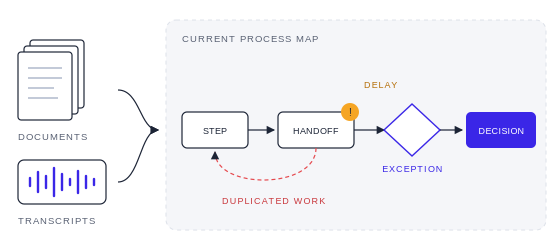
Bluthrive Process Mapping Software
Upload the documents that define how work is supposed to move and add transcripts from internal meetings that show how it actually moves.
The same Bluthrive AI used in every client implementation turns that operational evidence into a map of your current process—steps, handoffs, delays, duplicated work, exceptions, and decision points. It then helps redesign the process with AI in mind before any automation is built.
✓
Free Operations Roadmap Call
Start with the operation. Identify the bottleneck creating the most recurring drag and determine the right first workflow to address.
✓
30-day, no-questions-asked money-back guarantee
If you are not happy for any reason during your first 30 days, tell us and Bluthrive will refund your first monthly payment. No questions asked.
✓
Cancel any month
No long-term commitment is required.
“We Are Builders, Not Tech People.”
Good. You should not have to become a software team to remove repetitive work from your business.
Bluthrive handles the technical implementation. Your team explains how the work really happens, identifies the exceptions that matter, and retains control of the decisions.
The system is designed around the process—not around making your people learn AI jargon.
“My Team Will Not Adopt Another Tool.”
That concern is valid.
A technically impressive system that the field or office will not use has no operational value.
That is why the Simple AI System maps the real workflow, integrates with the tools the team already uses, trains the users, and measures adoption after launch.
The objective is not another login. It is less copying, less chasing, and a clearer next step inside the work people already do.
“What If the AI Is Wrong?”
AI can be wrong. Software can be wrong. Inputs can be incomplete.
The answer is not blind trust. It is controlled use.
The system gives AI a bounded role: prepare, organize, route, draft, compare, summarize, and flag. Qualified people review the output and make decisions involving money, contracts, safety, measurements, pricing, scope, approvals, and client commitments.
Accountability stays with the company and its qualified people. The workflow is designed to support that responsibility, not hide it.
“We Already Have Project Management, Accounting, and CRM Software.”
That is expected.
The problem is often not the absence of software. It is the manual work between systems, the follow-up that depends on memory, and the information that reaches the next person too late.
The Simple AI System integrates with the tools the team already uses. It does not begin by asking you to replace the company’s core software.
Where a separate third-party platform is needed, its subscription is billed directly by the provider.
“This Sounds Expensive and Complicated.”
The Simple AI System is $800 per month and can be canceled any month.
The work is narrowed to one recurring bottleneck at a time. The process is mapped before code. The first useful automation goes live within 14 days. Then one new production-grade automation is installed each month.
You do not have to fund a company-wide overhaul or manage a long software project before the team sees a useful workflow.
Two Guarantees. The Risk Stays With Bluthrive.
30
30-Day Money-Back Guarantee
You should not have to carry the risk while deciding whether the Simple AI System is right for your operation.
If you are not happy for any reason during your first 30 days, tell us and Bluthrive will refund your first monthly payment. No questions asked.
You get the first month to see how Bluthrive maps the process, works with your team, and moves the first useful automation toward production. The financial risk during those first 30 days stays with us.
90
90-Day Performance Guarantee
The Simple AI System also comes with a 90-day performance guarantee:
If the system does not save more time and money than it costs in the first 90 days, Bluthrive keeps working at no additional charge until it is net-positive.
That keeps the focus where it belongs: useful operating results, not technical activity.
The system is measured against the workflow it was built to improve. Time saved, turnaround, errors caught, and team adoption remain visible throughout the process.
The Simple AI System Is a Strong Fit If…
✓
You run a commercial or retail construction company with recurring administrative bottlenecks.
✓
Skilled people are spending too much time copying information, preparing routine work, and chasing follow-up.
✓
Important handoffs still depend on texts, inboxes, memory, or one person knowing what happens next.
✓
You want more capacity from the team you already have.
✓
You want to keep experienced people in control of pricing, contracts, safety, scope, measurements, approvals, and client commitments.
✓
You are willing to let Bluthrive map how the work actually happens—not only how the SOP says it should happen.
✓
You want to improve one useful workflow at a time and measure whether the team uses it.
It Is Not a Fit If…
✕
You want AI to replace qualified estimators, PMs, superintendents, accounting staff, or leadership judgment.
✕
You want unchecked software making decisions about money, contracts, safety, scope, pricing, measurements, approvals, or client commitments.
✕
You are looking only for a chatbot, dashboard, generic template, or stand-alone software license.
✕
You are unwilling to involve the people who actually perform and review the workflow.
✕
You want to automate a process without first clarifying how it should work.
✕
You are not prepared to provide the access, operational context, feedback, and human review needed for a production workflow.
FAQ
No. It is a done-for-you monthly implementation service. Bluthrive maps the process, redesigns the workflow, builds the automation, integrates it with the tools the team already uses, trains users, and monitors the system.
The Simple AI System is $800 per month. You can cancel any month.
Third-party platform subscriptions are separate and billed directly by the providers.
Start with a Free Operations Roadmap Call. The goal is to identify the biggest recurring bottleneck and the right workflow to address first.
Once implementation begins, Bluthrive maps and redesigns that process before building the automation.
The first useful automation goes live within 14 days.
Bluthrive installs one new production-grade automation each month. The service also includes team training, 24/7 monitoring, maintenance and support, and one hour of direct expert access monthly.
The service integrates with tools the team already uses. The starting point is the current operation and software environment—not a forced replacement project.
If a separate third-party platform is required, its subscription is billed directly by that provider.
No technical background is required. Bluthrive handles the implementation and trains the team on the workflow in plain English.
Your people still need to provide process knowledge, review outputs, and make the decisions that require their qualifications and authority.
No. The system is designed to remove repetitive administrative work around experienced people—not replace their judgment.
AI can prepare, organize, route, draft, compare, summarize, and flag. Qualified people review and decide.
The workflow defines what AI may handle, where human review is required, who owns the review, and what cannot move forward without approval.
Money, contracts, safety, measurements, pricing, scope, approvals, and client commitments remain under qualified human control.
Bluthrive uses its process mapping software to combine your uploaded operating documents with transcripts from internal meetings. Our AI maps how the work currently moves, identifies bottlenecks and handoff problems, and helps redesign the process with AI in mind.
Bluthrive and your team then choose a first target that is useful, repeatable, reviewable, and tied to an operational result the company can measure.
The system is evaluated using practical measures such as time saved, turnaround, errors caught, and team adoption.
The relevant measure depends on the workflow. A bid-review process may focus on turnaround and caught exceptions. A follow-up process may focus on speed and consistency. A field-to-office handoff may focus on time saved and missing information.
The service includes 24/7 monitoring, maintenance, and support, plus one hour of direct expert access each month.
The 30-day money-back guarantee applies. If you are not happy for any reason during your first 30 days, tell us and Bluthrive will refund your first monthly payment. No questions asked.
The 90-day performance guarantee applies: if the system does not save more time and money than it costs in the first 90 days, Bluthrive keeps working at no additional charge until it is net-positive.
Yes. You can cancel any month.
Give Your Team More Capacity Without Giving Up Control
Your construction company does not need another AI tool looking for a problem.
It needs one recurring bottleneck mapped clearly, redesigned properly, and improved inside the operation your people already run.
Start with the process slowing down bids, jobs, follow-up, billing, cash flow, or owner decisions.
See where AI can prepare and organize the work. Define where qualified people must review it. Then build the first useful automation around a measurable operational result.
$800 per month. First useful automation live within 14 days. One new production-grade automation installed each month. Cancel any month. Protected by a 30-day, no-questions-asked money-back guarantee and backed by the 90-day performance guarantee.

Bluthrive: where automation meets freedom.
Copyright 2026 — All Rights Reserved