
Time Is Your Superpower: How Automation Unlocks Hours You Didn’t Know You Had
Thursday, July 31, 2025
Unlocking Your Hidden Hours:
How Automation Tools Give You
Your Time Back
Unlocking Your Hidden Hours:
How Automation Tools Give You Your Time Back
Ever wish you had a few extra hours every day? Imagine sipping your morning coffee while your inbox organizes itself, invoices send without your intervention, and your social media posts appear like clockwork—even as you dream. Sound like science fiction? The magic is real, and it’s called automation. In this rapidly shifting digital world, automation isn’t just a buzzword—it’s the secret weapon that gives ordinary people superhuman efficiency. Ready to discover how these invisible engines work for you?
Ever wish you had a few extra hours every day? Imagine sipping your morning coffee while your inbox organizes itself, invoices send without your intervention, and your social media posts appear like clockwork—even as you dream. Sound like science fiction? The magic is real, and it’s called automation. In this rapidly shifting digital world, automation isn’t just a buzzword—it’s the secret weapon that gives ordinary people superhuman efficiency. Ready to discover how these invisible engines work for you?
The Power Players Behind the Curtain: A Modern-Day Story of Automation
Not long ago, I was juggling too many balls—emails piling up, data scattered across a dozen apps, and customer messages coming in faster than I could answer. Friday evenings became synonymous with spreadsheets instead of the freedom I craved. Something had to change.
That’s when I decided to dive headfirst into the world of automation tools. The journey began with the well-known staples: Zapier and IFTTT. I was amazed at how easily I could “connect” my apps. Suddenly, whenever I got a new lead via Typeform, it appeared in my CRM and triggered a welcome email, all without a single click from me.
Next, tools like Make (formerly Integromat) took things further. By allowing complex scenarios—like collating data from multiple sources, applying filters, and sending it exactly where it needed to go—Make was like having a digital assistant with an MBA. Tasks that would have needed painstaking human attention became seamless and error-free.
Social media? That was tamed by using Buffer and Hootsuite, which let me schedule week’s worth of posts in one sitting, analyze engagement, and never miss an important comment again.
But then, I stumbled on a new breed of tools leveraging artificial intelligence. Stack Ai caught my attention. While classic automation platforms excel at connecting services, Stack Ai pushes the boundary: With its no-code interface, I could train AI workflows, automate text analysis, and even build chatbots tailored to my business logic—without hiring a single developer. Stack Ai let me automate complex decision-making, thanks to natural language processing, and integrate these results into my existing automations with just a few clicks.
Finally, on the financial side, apps like QuickBooks Online and Xero automate invoicing and reconciliation—making end-of-month a breeze instead of a nightmare.
What happened next? Freedom. My work became less about mundane tasks, and more about strategy, creativity, and human connection—the things only I can do.
Key Takeaways: Turning Time into Your Superpower
- Connect the dots: Tools like Zapier, IFTTT, and Make allow you to link your favorite apps without coding.
- Level up with AI: Stack Ai lets you add machine learning and natural language processing to your workflows, making automation smarter than ever.
- Dominate social media and communications: Buffer, Hootsuite, and similar platforms keep your online presence fresh with minimal effort.
- Financial peace of mind: QuickBooks and Xero cut hours off your bookkeeping routine.
- Freedom awaits: The real win isn’t just saving time, but unlocking your creativity, focus, and energy.
In a digital world, the best use of your human talents is letting the robots handle the robots’ work. Dive into automation and discover not just what you can save—but what you can become.
Key Takeaways:
Turning Time into Your Superpower
- Connect the dots: Tools like Zapier, IFTTT, and Make allow you to link your favorite apps without coding.
- Level up with AI: Stack Ai lets you add machine learning and natural language processing to your workflows, making automation smarter than ever.
- Dominate social media and communications: Buffer, Hootsuite, and similar platforms keep your online presence fresh with minimal effort.
- Financial peace of mind: QuickBooks and Xero cut hours off your bookkeeping routine.
- Freedom awaits: The real win isn’t just saving time, but unlocking your creativity, focus, and energy.
In a digital world, the best use of your human talents is letting the robots handle the robots’ work. Dive into automation and discover not just what you can save—but what you can become.
Join the Bluthrive community of driven entrepreneurs achieving more freedom through smart automation.
READY TO CUT COSTS, SAVE TIME, AND FOCUS ON GROWTH? LET’S MAKE IT HAPPEN!
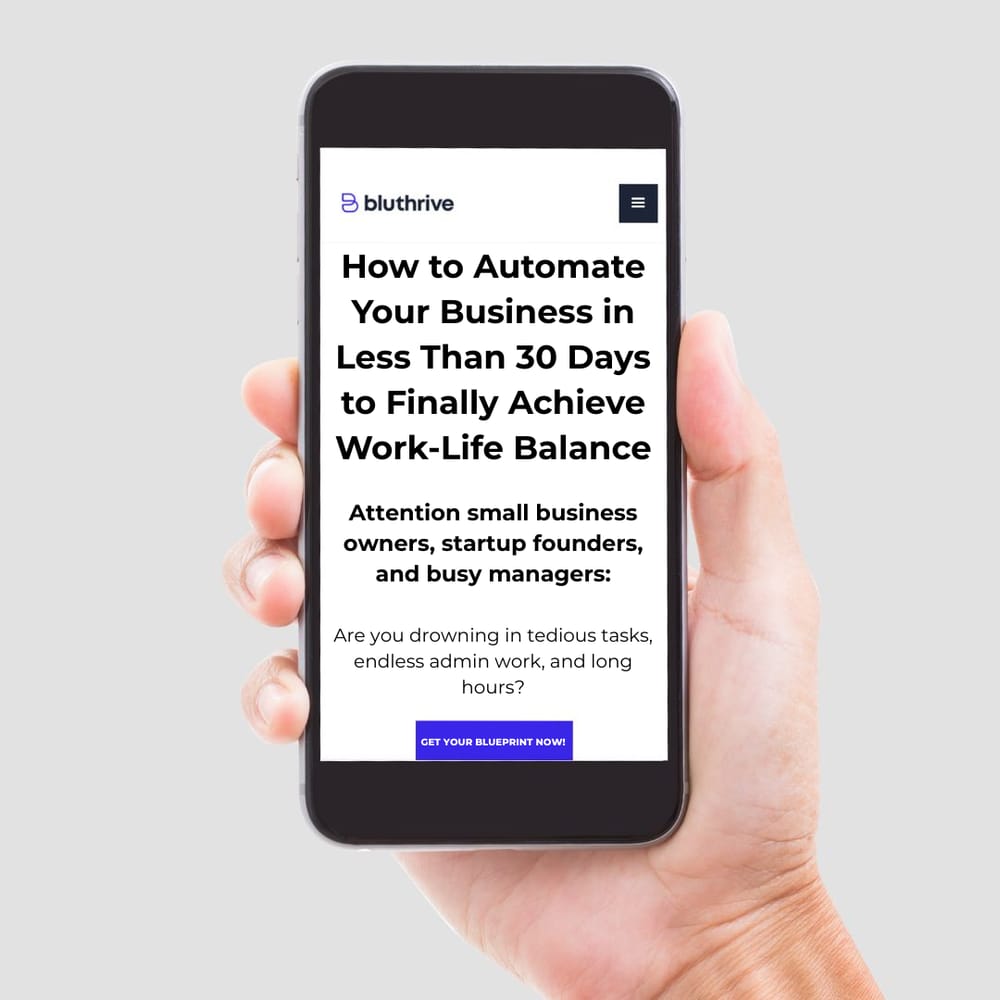

Bluthrive: where automation meets freedom.
Copyright 2026 — All Rights Reserved