
How AI Automation Lets You Grow Revenue Without Overloading HR (or Burning Out Your People)
Tuesday, February 10, 2026
For most companies, growth follows a familiar pattern:
Revenue increases → demand increases → workload increases → you hire.
That formula worked for decades because work was mostly manual, coordination-heavy, and dependent on human follow-through. If you wanted more output, you needed more people to produce it.
But we’re entering a different era.
In 2026, the businesses that scale fastest aren’t the ones that hire fastest. They’re the ones that redesign how work moves through the company. Instead of increasing headcount to absorb growth, they use AI automation to remove friction, reduce handoffs, and turn messy human-dependent operations into structured systems.
This is what “scaling teams without scaling headcount” actually means:
Growing revenue without increasing the internal load on HR, managers, and top performers.
Not by squeezing employees harder.
Not by expecting people to “do more with less.”
But by building an operating system where the business can handle more volume with less coordination.
And the key isn’t adopting AI tools.
The key is embedding automation into the three places where companies break when they grow:
onboarding, role workflows, and self-serve systems.
The Real Problem Isn’t Workload. It’s Coordination.
Most leaders assume burnout happens because there’s too much work.
That’s rarely the full truth.
Burnout usually comes from how work is organized.
When a company scales, it doesn’t just add tasks. It adds complexity. The number of moving parts increases: more clients, more projects, more exceptions, more tools, more requests, more internal dependencies. And as complexity rises, so does the coordination cost.
That coordination cost shows up as:
- constant Slack interruptions,
- endless “quick questions,”
- meetings that exist only to keep people aligned,
- and managers acting like human routers.
In this environment, HR becomes a bottleneck. Operations becomes reactive. And your best employees become the glue holding everything together — which is why they’re also the first to burn out.
Here’s the uncomfortable truth:
Most businesses don’t scale by doing more work.
They scale by doing more handoffs.
And handoffs are where things break.
That’s why AI automation matters so much. It doesn’t just “save time.” It reduces the amount of coordination required to run the business.
What AI Automation Changes (That Most Leaders Miss)
A lot of companies still treat AI like a productivity add-on.
They use it to write faster emails, generate marketing copy, summarize meetings. Helpful, sure — but that doesn’t change the structure of the business. It just makes individuals slightly faster inside the same chaotic system.
The real power of AI comes when it becomes operational.
That means AI isn’t a tool you open. It’s something embedded into workflows so work moves automatically: routed, checked, triggered, documented, escalated. When done correctly, AI reduces the number of times humans have to coordinate with humans.
And when coordination decreases, something powerful happens:
You can increase volume without increasing internal stress.
That’s how you scale revenue without scaling headcount.
The 3 Levers That Let You Scale Without Hiring Like Crazy
If you want to grow without creating HR overload or team burnout, there are three places to focus. Not 20. Not 50.
Just three.
The 3 Levers That Let You Scale Without Hiring Like Crazy
If you want to grow without creating HR overload or team burnout, there are three places to focus. Not 20. Not 50.
Just three.
1) Automated Onboarding: Stop Making HR and Managers Repeat Themselves
Onboarding is one of the most underestimated scaling constraints.
Because onboarding isn’t just paperwork. It’s the process of turning a new hire into a productive contributor — and most companies do this in a way that doesn’t scale.
Typically, onboarding depends on people:
- HR scheduling meetings and sending links,
- managers explaining processes verbally,
- teammates answering repeated questions,
- and new hires “shadowing” whoever is available.
That works at 5 employees. It breaks at 25. And at 50+, it becomes a quiet disaster: inconsistent training, slow ramp time, and overwhelmed leadership.
AI automation changes onboarding by turning it into a system instead of an event.
Instead of onboarding being something HR “does,” onboarding becomes something the company runs. New hires get access automatically. They receive role-specific learning paths. They complete checklists that trigger next steps. And most importantly: they don’t need to interrupt humans every time they need context.
The breakthrough is when you create an AI onboarding assistant trained on your internal SOPs, policies, and role documentation. Then new hires can ask:
“Where do I find the client intake process?”
“What’s the standard response when a customer asks for X?”
“How do we escalate an issue?”
And they get an instant answer — aligned with the company’s actual process — without waiting for someone to respond.
This is how you reduce HR load while improving onboarding quality at the same time.
2) Role Workflows: Turn Tribal Knowledge Into Repeatable Execution
The biggest scaling mistake is building a business where performance depends on “great people.”
Great people are important — but if they’re the only reason things work, you don’t have a scalable company. You have heroic labor.
When work lives in someone’s head, every task becomes custom. Every project requires extra clarification. Every exception requires a meeting. That’s why scaling creates pressure: the business is growing, but execution remains fragile.
AI automation helps by turning roles into workflows.
That means you define what happens when something occurs — not in a vague “SOP doc,” but in an actual operational sequence that triggers actions.
For example, when a deal closes, the system automatically launches the onboarding workflow, creates tasks, routes responsibilities, validates missing information, and alerts the right people only when human judgment is needed.
This is what modern workflow automation looks like: AI doesn’t replace people. It replaces the glue work that people hate — chasing updates, copying data, reminding others, tracking status, coordinating handoffs.
And once workflows are role-based, you unlock something that most companies never achieve:
You can grow output without increasing management overhead.
Because managers stop being the workflow. The workflow becomes the workflow.
3) Self-Serve Systems: Replace Interruptions With Infrastructure
If onboarding is how people enter the company, and workflows are how work gets executed…
Self-serve systems are what prevent the company from collapsing into constant interruption.
Most businesses don’t realize how much of their time is spent on internal requests:
- “Can you send me the template?”
- “What’s the process for this?”
- “Who owns that?”
- “Where’s the latest version?”
- “Can you approve this?”
These look like small questions, but they destroy momentum. And as headcount grows, interruptions don’t grow linearly — they grow exponentially.
This is where self-serve systems create massive leverage.
A self-serve company doesn’t require employees to “ask someone.” It gives them access to systems where they can find answers, submit requests, and get outcomes without bottlenecking a human.
AI makes self-serve far more powerful than traditional knowledge bases because it solves the biggest problem documentation always had:
People don’t search properly. They ask.
So instead of forcing employees to dig through folders, you give them an AI interface that understands intent and returns the correct SOP, form, template, or escalation path.
That single shift reduces Slack noise, reduces dependency, and reduces burnout — especially for your operations team and managers.
The Business Outcome: Revenue Growth Without Internal Overload
When you combine these three levers, something important happens:
The business stops scaling through humans.
It scales through systems.
That creates three major outcomes:
- HR stops becoming the bottleneck
- Managers stop becoming coordinators
- Employees stop burning out from constant interruption
And that’s the real promise of AI automation in scaling:
Not replacing employees — but protecting them from chaos.
The Companies That Win in 2026 Will Build Operational Leverage
In the next phase of business growth, scale won’t be determined by who can hire faster.
It will be determined by who can execute consistently as volume increases.
Some companies will respond to growth by stacking headcount on top of broken processes. They’ll grow, but they’ll feel heavier, slower, and more stressful every quarter.
Other companies will respond by building automation into the structure of work itself: onboarding, workflows, and self-serve systems.
Those businesses won’t just scale revenue.
They’ll scale clarity.
They’ll scale stability.
They’ll scale performance — without scaling burnout.
And in 2026, that difference will compound.
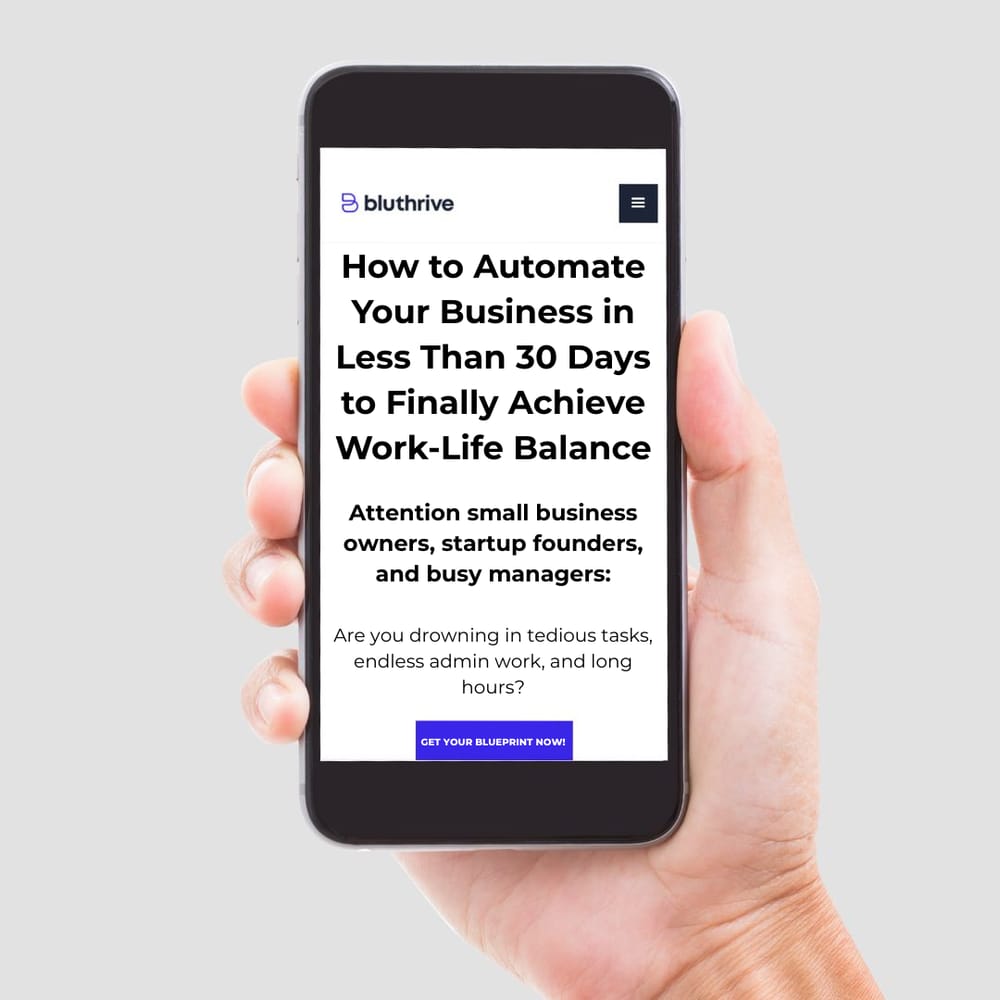
Join the Bluthrive community of driven entrepreneurs achieving more freedom through smart automation.
READY TO CUT COSTS, SAVE TIME, AND FOCUS ON GROWTH? LET’S MAKE IT HAPPEN!

Bluthrive: where automation meets freedom.
Copyright 2026 — All Rights Reserved